Whether it is a child’s comforting bedtime companion, a vintage heirloom passed down through generations, or an intricately crafted Custom Crochet Doll commissioned for an anniversary, soft toys absorb far more than just love. Over months and years of constant embraces, bedtime routines, and floor play, plush toys accumulate a heavy load of microscopic debris: sloughed-off skin cells, dust mites, accidental juice spills, airborne cooking oils, and stubborn odors.
Yet, tossing a beloved plushie directly into a high-heat washing machine can lead to disaster: melted faux fur, unraveling embroidery threads, clumping batting, and distorted facial features. Knowing how to clean stuffed animals properly is a delicate balance of fiber science, patience, and restoration techniques.
This comprehensive guide covers everything from routine maintenance and heavy-duty spot removal to full submersible washing and fluffing. Along the way, we explore how to safeguard delicate handmade fiber art, offering practical care techniques for store-bought plush, personalized stuffed animals, and treasured art pieces.
Pre-Wash Assessment: Fiber Anatomy, Care Labels, and Structural Hazards
Before water or detergent touches fabric, you must perform a thorough physical and structural assessment. Many ruined toys are the victims of a rush to the washing machine without checking the construction underneath.
Stuffed Animal Pre-Wash Triage Checklist:
-
Step 1: Structural Integrity Check: Inspect all seams, limbs, and eyes. If you find loose seams or holes, sew them closed with needle and thread before introducing liquid.
-
Step 2: Fiber Identification: Determine if the exterior is faux fur, minky, cotton, or yarn. Synthetic fibers like acrylic and faux fur are heat-sensitive, while natural wool fibers risk permanent shrinkage and felting.
-
Step 3: Internal Elements Inspection: Check for mechanical components such as music boxes, sound modules, squeakers, metal wires, or internal battery compartments. Never submerge mechanical or electronic toys in water.
-
Step 4: Cleaning Route Decision: Delicate heirlooms, vintage pieces, and handmade yarn art require hand-washing or spot-cleaning. Sturdy everyday toys with machine-safe care tags can tolerate a gentle cold machine cycle.
Checking the Manufacturer Label vs. Handmade Art
Store-bought commercial toys usually have an ASTM safety tag with textile composition details (most often 100% polyester fiberfill and polyester plush). If the tag indicates "Surface Wash Only," take it seriously. It usually implies that internal batting, cardboard stiffeners, glue, or wire armatures cannot endure full water immersion.
Conversely, if you possess a Handmade collectible—such as a piece from a specialized Doll Maker or a custom Crochet character—there are rarely commercial care labels attached. You must evaluate the fibers manually:
-
Cotton Yarn: Resilient and breathable, but prone to shrinking in hot water and prolonged drying times.
-
Acrylic Yarn: Durable and colorfast, but synthetic plastic fibers melt easily under high heat.
-
Wool / Alpaca Blends: Prone to irreversible felting if exposed to friction and warm water simultaneously.
The Structural Integrity Inspection
Hold the toy under bright light. Examine the seams along the back, arm sockets, and neck. If there are micro-tears or loosening threads, sewing them shut with a basic ladder stitch before washing prevents the internal stuffing from escaping into your washing drum or washbasin.
Identifying Internal Electronics, Joint Pins, and Cardboard Inserts
-
Sound Modules & Batteries: Mechanical voices, vibrating boxes, or light-up mechanisms will corrode and short-circuit if submerged. These pieces must be strictly spot-cleaned or opened via a discreet seam, the mechanism removed, the body washed, and the unit re-sewn.
-
Cardboard Stabilizers: Older heritage toys, vintage teddy bears, and certain custom stands use compressed cardboard in the footpads or base to help the toy stand upright. Immersion dissolves this cardboard into an unrecoverable soggy pulp.
-
Plastic Safety Eyes vs. Hand-Stitched Details: While securely fastened safety eyes handle cool water well, glued felt eyes or hand-painted wooden details can detach or bleed. Hand-embroidered features seen on Stitched People and artisanal dolls need protection from abrasive friction.
The Delicate Art of Spot-Cleaning: Targeted Stain Removal Without Submersion
For delicate pieces, high-end textile keepsakes, and heirloom custom stuffed animals, total immersion should be a last resort. Spot cleaning keeps the internal batting dry, preventing the growth of mold or mildew within the dense core of the toy.
Quick Stain Removal Reference Table
| Stain Category | Recommended Cleaning Agent | Step-by-Step Action |
| Milk, Formula & Drool | Cold water mixed with an enzyme liquid detergent | Blot gently with a damp cloth; avoid warm water to prevent setting proteins |
| Juice, Soda & Berry Stains | 50/50 mix of white distilled vinegar and cool water | Dab working strictly from the outside edge toward the center |
| Dried Dirt & Surface Mud | Soft-bristled brush followed by diluted mild soap | Let mud dry fully first, gently dry-brush away, then dab remaining spot |
| Grease, Oil & Lotions | Cornstarch or baking soda, followed by diluted dish soap | Dust powder to absorb oils, wait 1 hour, vacuum, then dab with soap |
Chemistry of Everyday Stains
-
Protein Stains (Milk, Drool, Blood, Food Purees): Never use hot water. Heat coagulates proteins, binding them permanently into synthetic and cotton fibers. Instead, mix cool water with an enzyme-based liquid detergent or a baby-safe laundry formula like Dreft Baby Detergent.
-
Tannin & Dye Stains (Fruit Juice, Berries, Markers): Prepare a solution of equal parts white distilled vinegar and lukewarm water with a drop of clear dishwashing liquid. The mild acid breaks down the tannin bonds without stripping the base yarn dye.
-
Grease and Body Oils: Dust greasy patches with cornstarch or baking soda. Allow it to sit for an hour to absorb the lipid layer, gently vacuum off with an upholstery nozzle, then treat residual discoloration with diluted, degreasing soap.
The Gentle Dabbing Technique
Never scrub vigorously back and forth on plush or knit fabrics; doing so frays yarn and creates irreversible fuzz ("pilling") on faux fur.
-
Moisten a clean, lint-free white microfiber towel with your cleaning solution.
-
Dab firmly from the outside edge of the stain inward to avoid spreading the perimeter.
-
Use a second cloth dampened with pure distilled water to press down and pull out soapy residues. Trapped soap attracts ambient dust later if left unrinsed.
The Washing Machine Protocol: Protecting Durable Plushies and Modern Stuffies
When everyday store-bought plush or sturdy stuffies need sanitizing—especially after illness or extended outdoor play—machine washing is viable if protective measures are followed.
Recommended Machine Wash Steps:
-
Surface Vacuuming: Use an upholstery nozzle to vacuum away loose dust, crumbs, and loose pet dander.
-
Protective Encasement: Always place the plush inside a zippered mesh laundry bag or a tied white cotton pillowcase.
-
Drum Balancing: Add two to three clean, light-colored cotton towels into the drum to absorb drum impacts and prevent wobbling.
-
Cycle Settings: Select the Delicate or Gentle cycle, running on strictly cold water (below 30°C / 85°F).
-
Detergent Dosing: Use only 1 to 2 teaspoons of a gentle, unscented, dye-free liquid detergent.
-
Spin Speed: Keep the spin cycle on Low or Medium speed to avoid stretching interior seams or tearing limb joints.
Step 1: Pre-Wash Mechanical Dust Extraction
Before introducing moisture, take the toy outside and gently clap it between your hands, or use an upholstery vacuum attachment fitted with a nylon stocking over the nozzle. This pulls out dry pet dander, loose grit, and surface dust mites so they do not turn into mud when wet.
Step 2: Mesh Laundry Bags Are Non-Negotiable
Never drop a plushie freely into an open washing machine tub. Agitators can snare ears, pull out sewn limbs, and scorch faux fur via friction against the drum wall. Place the plush inside a finely woven, zippered mesh laundry bag. If you do not have one, slide the toy into a clean white pillowcase and seal the opening tightly with a non-staining hair scrunchie or a secure knot.
Step 3: Drum Balancing
Washing a lone plushie causes the machine drum to wobble violently during the spin cycle, leading to high-speed impacts that damage seams. Wash the plush alongside a few white cotton bath towels. The towels cushion the toy and distribute water weight evenly across the drum.
Step 4: Temperature, Cycle, and Detergent Selection
-
Cycle: Select Delicate, Hand Wash, or Gentle.
-
Water Temperature: Keep it strictly Cold (maximum 30°C / 85°F). Synthetic pile fabrics, plush minky, and acrylic yarns are thermoplastic; warm or hot water alters the fiber memory, leading to rough textures.
-
Detergent Amount: Use no more than 1 to 2 teaspoons of a clear, dye-free, scent-free detergent. Conventional doses create heavy suds that are nearly impossible to rinse clean from dense inner polyester batting.
-
Skip Fabric Softeners: Never add liquid fabric softener or scent beads. These coat plush fibers in a silicone-based hydrophobic film, matting the pile and permanently attracting grime.
Hand-Washing & Submersion Care for Heirlooms, Crochet, and Custom Dolls
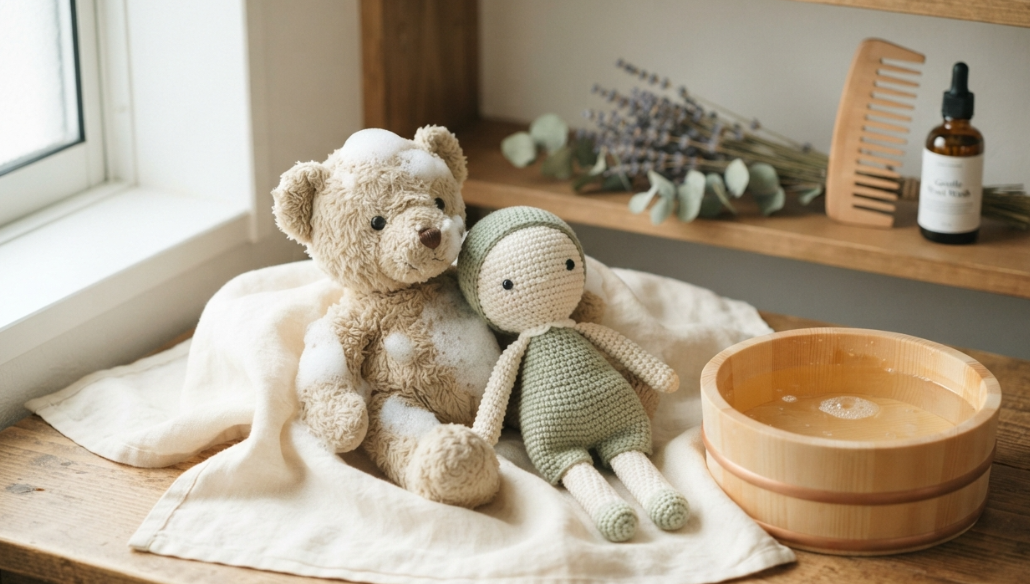
Artisanal toys, collector items, and customized gifts require a traditional, hands-on bath. If you own a Portrait Doll, a Look Like Me Knit Doll, a one-of-a-kind Custom Doll, or an intricate Crochet Doll, follow this step-by-step submersion routine.
The Hand-Wash Restoration Workflow:
-
Stage 1: Basin Preparation: Clean and sanitize a washbasin. Fill with cold to lukewarm water and dissolve a capful of no-rinse wool wash or gentle baby shampoo.
-
Stage 2: Immersion and Pulse Compressions: Submerge the doll gently. Compress and release the torso smoothly with your palms to cycle soapy water through the batting. Let soak undisturbed for 15 to 20 minutes without scrubbing or wringing.
-
Stage 3: Thorough Suds Extraction: If using standard soap, flush with clean cold water until runoff is completely clear.
-
Stage 4: The Towel-Roll Technique: Roll the damp doll tightly inside a clean bath towel like a burrito and press down evenly with your arms to push out core water without twisting stitches.
Step 1: Prepare the Spa Basin
Thoroughly clean and sanitize a clean washbasin or ceramic sink. Fill it with cool to lukewarm water. Add a dime-sized amount of a gentle, pH-balanced wool wash like Eucalan No-Rinse Wash or mild baby shampoo. No-rinse wool washes containing lanolin are ideal for natural animal fibers and acrylic yarns alike, keeping fibers supple without requiring aggressive rinsing.
Step 2: Gentle Submersion and Pulse Agitation
Lower the Custom Crochet doll into the water. Instead of swirling, scrubbing, or twisting the figure, use a gentle "pulsing" method: slowly submerge the body and press down with open palms, allowing the soapy solution to seep into the internal stuffing, then release so the core expands and draws fresh water in. Repeat this 8 to 10 times, then let the toy soak undisturbed for 15 to 20 minutes.
Step 3: The Clear-Water Rinse Routine
If using standard detergent rather than a no-rinse wash, drain the dirty water completely while carefully supporting the heavy, wet doll with both hands. Fill the basin with clean, cold water. Compress the doll repeatedly to flush out residual detergent. Continue refilling and draining until the runoff water is clear of suds.
Step 4: The Burrito Towel-Roll Extraction (Never Wring!)
Never grasp a wet doll by its arms or head; wet fibers carry significant water weight, and the seams can stretch or snap. Do not twist or wring the toy.
Lay a thick, dry bath towel flat on a table. Place the doll in the center, fold the towel over it, and roll it tightly into a spiral—like a burrito. Press downward evenly along the towel cylinder with your forearms. The dry terrycloth will absorb up to 70% of the trapped water from the doll’s core without distorting its shape.
Drying, Deodorizing, and Surface Fluffing: Preventing Mildew and Matting
The wash is only half the battle. Mold, mildew, and fiber melting occur primarily during improper drying.
Air Drying vs. Machine Tumble Drying:
-
Air Drying (Strongly Recommended for All Plush and Dolls):
-
Lay the item flat horizontally across an elevated, coated wire rack.
-
Keep in a room with active cross-ventilation or place an electric floor fan directly nearby.
-
Dry indoors away from harsh, direct sunlight to avoid dye bleaching.
-
-
Machine Dryer Fluffing (Use with Extreme Caution):
-
Use the No Heat / Air Fluff setting only; synthetic fibers melt quickly under heat.
-
Keep the toy secured in a thick laundry bag or pillowcase.
-
Check every 10 minutes to verify no friction heat builds inside the drum.
-
The Hazards of High-Heat Mechanical Dryers
Synthetic furs (often modacrylic or polyester) have low heat thresholds. Placing your plushie inside a standard clothes dryer on Medium or High heat will cause the fiber ends to melt together within minutes, resulting in an unfixable rough texture colloquially called "dryer burn."
The Ideal Setup: Ambient Air Convection
The safest method to dry any plush is horizontal air drying:
-
Rest the toy flat on an elevated plastic or coated-wire clothes rack so air circulates underneath it.
-
Avoid hanging by ears, limbs, or hair with clothespins; wet stuffing shifts downward, causing permanent sagging.
-
Position an electric room fan blowing directly across the drying surface to maintain consistent airflow. Circulating air reduces drying time from two days to under 12 hours, eliminating the damp window during which mildew spores thrive.
-
Keep the toy out of scorching, direct sunlight, which can fade bright fabric dyes and yellow pale yarns.
Odor Elimination: The Dry Baking Soda Chamber
If a vintage plush or custom plushie smells musty or carries ambient smoke odors, but cannot tolerate water baths, use an odorless dry bath:
-
Place the dry toy into a large resealable zip bag or clean pillowcase.
-
Pour in 1/2 cup of pure baking soda (optionally mixed with 2 tablespoons of cornstarch).
-
Seal the container and gently shake it for 60 seconds, coating the entire outer surface.
-
Let it rest for 4 to 8 hours. The alkaline sodium bicarbonate will absorb volatile aromatic compounds trapped in the fibers.
-
Take the toy outside and use a medium-soft bristle brush or a low-suction hand vacuum to remove all residual powder.
Fluffing and Grooming the Coat
Once completely dry:
-
For Short Plush / Minky: Rub the surface in small circles with a clean dry microfiber cloth to lift matted pile.
-
For Long Faux Fur: Use a fine pet slicker brush or a clean metal wig comb. Work gently through the tips in small, 1-inch increments, gradually working toward the roots to detangle matting.
-
For Yarn & Knitted Hair: Never use a wire pet brush on knitwear, as it unravels the twisted plies. Use a smooth wooden wide-tooth comb or your fingers to re-twist curls and arrange the hair locks of your Personalized Crochet Doll.
Preserving Generational Keepsakes and Custom Fiber Art
Plush items often carry sentimental weight far beyond that of an everyday store-bought toy. Whether it is an anniversary token like Dolls for Couple, commemorative Sister Dolls, or a handcrafted Picture of Baby to Doll heirloom, specialized textile art demands proactive preservation alongside regular cleaning.
Preservation and Display Best Practices:
-
Storage Bags: Store in breathable, 100% natural cotton canvas bags. Avoid airtight plastic storage bins, which trap ambient humidity and foster mildew growth.
-
Sunlight Protection: Position dolls away from direct southern-facing windows; UV light breaks down acrylic yarns and fades delicate dyes.
-
Dust Control: Display collector items in enclosed glass cabinets or dust with a soft makeup brush once every couple of weeks.
-
Temperature & Moisture Control: Maintain toys in climate-controlled spaces between 50°F and 70°F (10°C–21°C), keeping relative humidity under 55%.
The Value of Quality Craftsmanship
A major factor in how well a toy survives multiple cleanings is the original construction quality. Flimsy factory toys with loose, chain-stitched seams often deteriorate after a single cycle in the wash.
In contrast, custom fiber art created with double-wound yarn, reinforced safety joint backings, and balanced tension withstands years of careful maintenance. When looking for bespoke gifts—whether a whimsical Niece Gift, a custom look-alike piece, or commemorative Personalized Gifts—entrusting the work to a specialized studio ensures high-grade craftsmanship from the first stitch.
For those looking to turn personal memories, family photographs, or beloved characters into heirloom-grade textile art, explore the bespoke artisan collections at Apripex. Their artisans specialize in handcrafted, tailored dolls and plush items designed to endure as cherished keepsakes for years to come.
Expert Q&A: Real-World Inquiries from Reddit & Quora
To address real-world cleaning dilemmas, we researched top discussions from parenting, crafting, and textile care communities across Reddit and Quora.
Q1: How do I sanitize a plushie without ruining it after someone has been sick?
Community Source: Adapted from recurring community discussions on Reddit’s r/CleaningTips.
Expert Answer: Sanitizing without high heat (which ruins synthetic fur) can be tricky. While heat is a common disinfectant, hot water can melt faux fur and damage internal batting.
Instead, rely on chemistry and time:
-
Wash machine-safe toys on a cold, delicate cycle using an EPA-registered laundry sanitizer formulated for low temperatures (such as Lysol Laundry Sanitizer), which eliminates bacteria and viruses without heat.
-
If the toy is non-washable, seal it inside an airtight plastic bag and isolate it in a dry closet for at least 7 to 10 days; most common household viruses lose viability on dry porous textiles within several days.
-
Alternatively, lightly mist the toy with a fine aerosol of 70% isopropyl alcohol from at least 12 inches away—conduct a patch test on a hidden seam first—and let it dry in a well-ventilated room. Avoid saturating the fabric.
Q2: What is the safest way to clean a vintage 1980s teddy bear whose stuffing is deteriorating?
Community Source: Referencing vintage restoration challenges shared on Reddit’s r/Plushies Community.
Expert Answer: Vintage toys from the 1970s and 1980s are often filled with polyether foam or shredded sponge rubber. Over 30 to 40 years, this foam undergoes oxidative degradation, turning into a sticky residue or crumbling into fine, allergenic dust.
Under no circumstances should you submerge a toy with crumbling foam; water causes degraded foam to collapse into an irrecoverable slurry.
The professional restoration approach:
-
Carefully unstitch a 2- to 3-inch section of the rear ladder seam using a seam ripper.
-
Fully empty and discard the degraded vintage foam into a waste receptacle.
-
Hand-wash the empty textile "skin" in cool water using a gentle no-rinse wool wash.
-
Allow the skin to dry completely flat.
-
Re-stuff the toy with fresh, hypoallergenic polyester fiberfill, and close the opening using a strong polyester thread with a hidden ladder stitch. This preserves the original exterior while stabilizing the toy's structure for decades to come.
Q3: How do I clean handmade yarn dolls or knit items without causing them to pill or lose their shape?
Community Source: Addressing common maker inquiries on Quora’s Needlework & Crochet Care Hub.
Expert Answer: Handcrafted yarn dolls—such as a Custom Crochet Doll or amigurumi figure—differ significantly from woven plush. Machine washing should always be avoided. The friction of the drum creates surface fuzz and pills on twisted yarn fibers, and the mechanical spin stretches stitch tension, exposing the internal batting.
To clean:
-
Spot-clean surface dirt with a soft baby toothbrush dipped in cool, soapy water, dabbing lightly without rough scrubbing.
-
If hand-submerging, use cold water and a no-rinse cleanser. Never wring or twist the doll.
-
Use the towel-roll method described in Section 4 to squeeze out excess moisture, then place the piece on a clean, dry towel.
-
Gently reshape the limbs, facial features, and torso with your hands while damp (a process known in fiber arts as "blocking"). Let it air dry away from heat sources.
Q4: My stuffed animal’s faux fur has become coarse and matted ("dryer burned"). Can it be restored?
Community Source: Tackling the common laundry mishap discussed on Reddit's r/Laundry Community.
Expert Answer: When synthetic faux fur experiences excessive heat, the micro-fine plastic polymer tips curl, shrink, and fuse together. While extreme, melted damage is irreversible, minor to moderate surface matting can often be improved:
-
Prepare a spray bottle containing warm water mixed with one teaspoon of high-slip human hair conditioner or a silicone-based detangling spray.
-
Lightly mist the matted fur until it is barely damp.
-
Using a fine metal slicker brush (commonly used for dogs and cats), gently brush the affected area in very small, 1/2-inch sections, working from the ends toward the roots.
-
The conditioner reduces friction, allowing the brush pins to separate tangled and fused fibers.
-
Once loosened, wipe the coat with a damp microfiber cloth to remove residual conditioner, then allow it to air-dry naturally.
Q5: How do I eliminate persistent pet or damp basement smells from dense stuffed animals?
Community Source: Sourced from odor-removal discussions on Quora's Household Cleaning Advice.
Expert Answer: Stubborn, deep-seated odors in plush toys are caused by volatile organic compounds (VOCs) trapped deep within the dense polyester filling, where surface spot-cleaning cannot reach.
To eliminate odors without risking moisture damage:
-
The Activated Charcoal Method: Place the dry plush inside an airtight storage container alongside two breathable pouches of activated bamboo charcoal (available at home improvement stores). Activated charcoal has a high surface area that captures odor molecules over 48 to 72 hours without adding moisture.
-
The Sunshine & Fresh Air Method: Place the toy outdoors in a dry, shaded area on a day with low humidity and a gentle breeze. Sunlight contains natural UV rays that assist in neutralizing odors, but keep the toy in open shade to avoid fading bright surface dyes.
-
Steam Treatment (With Caution): For machine-safe toys with persistent smells, hover a garment steamer 3 to 4 inches away from the surface, letting warm vapor penetrate the top layer, followed immediately by thorough fan-drying.
Conclusion & Ongoing Care Recommendations
Learning how to clean stuffed animals is an essential skill for parents, collectors, and gift-givers alike. Soft toys are more than everyday home textiles; they hold childhood memories, mark family milestones, and represent thoughtful handcrafting.
By assessing fiber types before washing, choosing gentle spot-cleaning whenever possible, skipping the high-heat clothes dryer, and letting air circulation do the work, you can keep your companions clean and comfortable for years of hugs to come.
When choosing a meaningful heirloom—whether a Niece Gift, a custom anniversary piece, or a one-of-a-kind art figure—quality craftsmanship makes all the difference in durability. Explore unique, lovingly crafted designs and bespoke keepsakes at Apripex, where artisanal technique ensures your custom creations are built to last a lifetime.